
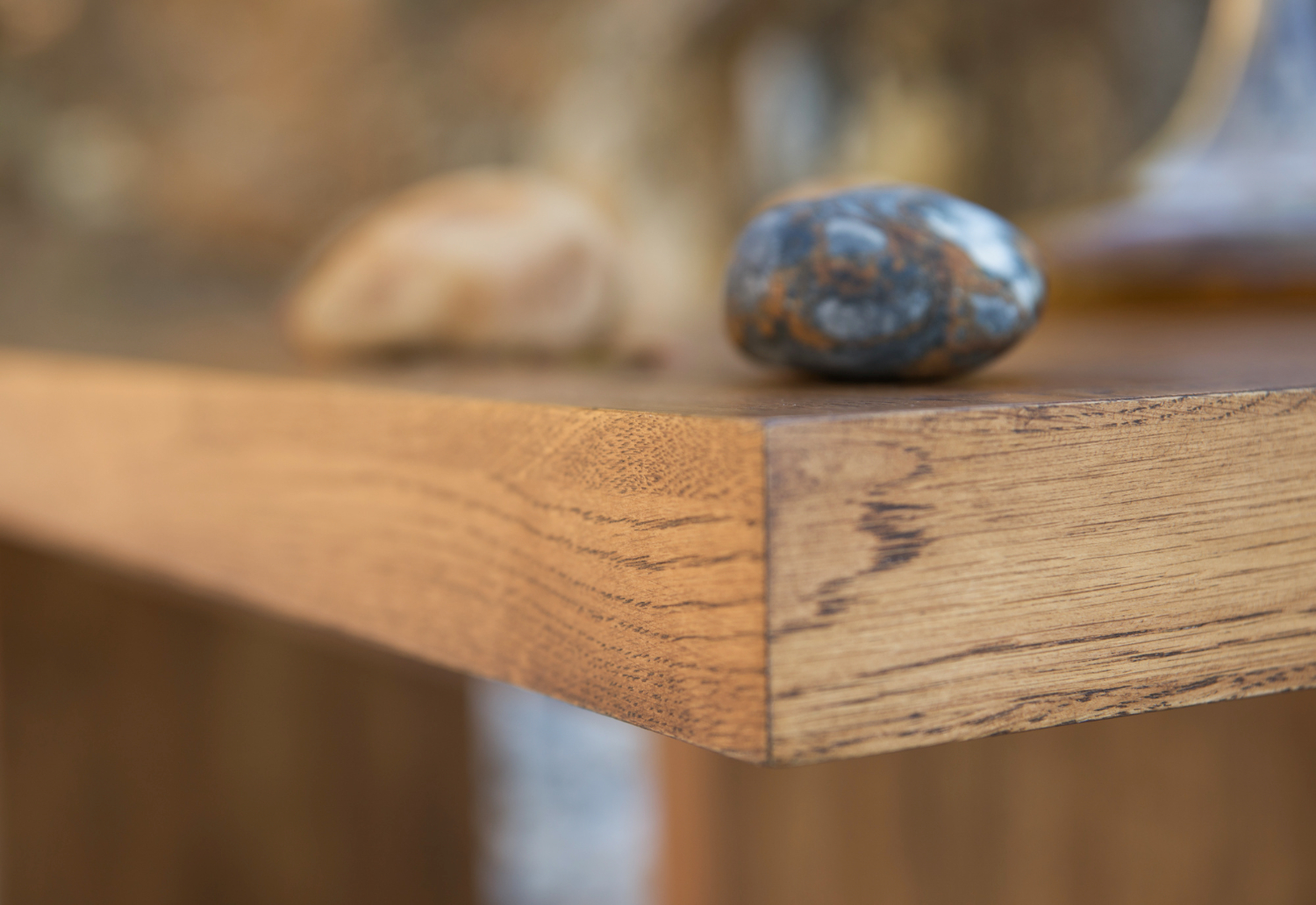
“Solid wood” gets thrown around a lot in furniture listings—and not always honestly. Plenty of pieces look like wood but are actually veneers, laminates, or printed finishes over engineered cores. Some of them are perfectly fine. Others are built to look good for about six months.
If you want to know what you’re really buying, you have to look past the surface.
Start With the Grain: Real Wood Isn’t Perfect
The easiest clue is the grain pattern.
Real wood has natural variation—knots, slight inconsistencies, changes in direction. Even within the same piece, the pattern won’t repeat exactly.
Fake wood (laminate or printed veneer) often gives itself away by being too consistent. You might notice:
- Identical grain patterns repeating across panels
- Symmetrical designs that look “printed”
- A slightly flat or artificial look up close
If it looks perfect, it’s probably not real.
Check the Edges (This Is the Tell Most People Miss)
Edges reveal more than the surface ever will.
- Real wood: the grain continues naturally through the edge
- Veneer: you’ll often see a thin top layer with a different material underneath
- Laminate: edges may have a plastic strip or a visible seam
Run your finger along the edge. If it feels like a separate layer, it usually is.
Look at the Underside
Flip the piece over or check hidden areas.
Manufacturers are less careful about disguising materials where you’re not supposed to look.
- Real wood will still show natural grain and texture underneath
- Engineered wood often looks smoother, more uniform, or slightly “compressed”
- Particleboard may look like compressed chips or sawdust
If the bottom looks completely different from the top, that’s a clue you’re dealing with a veneer or laminate.
Weight Tells You More Than You Think
Real wood is dense.
If a table or dresser feels unusually light for its size, it’s likely not solid wood. Engineered materials—especially particleboard—are often lighter (or sometimes oddly heavy but hollow-feeling).
A solid wood piece usually feels substantial and balanced when you try to move it.
Tap Test: Listen for the Difference
It sounds simple, but it works.
- Solid wood: dull, solid thud
- Hollow or engineered wood: more of a hollow or echo-like sound
It’s not foolproof, but combined with other clues, it helps.
Look for Joinery, Not Just Screws
How a piece is put together says a lot.
Real wood furniture often uses:
- Dovetail joints (common in drawers)
- Mortise-and-tenon construction
- Wooden dowels
Cheaper engineered pieces rely heavily on:
- Screws
- Cam locks
- Glue
That doesn’t automatically mean it’s bad—but it’s rarely solid wood.
Watch the Price (If It Feels Too Good, It Is)
A large “solid wood” dining table for a suspiciously low price is almost always a red flag.
Hardwoods are expensive to source and work with. If the price seems too good for the size and style, there’s usually a veneer or engineered core involved.
Smell Can Be a Clue
This one’s subtle, but real wood often has a natural, slightly earthy scent—especially when new.
Engineered wood may smell more like:
- Glue or chemicals
- Paint or laminate
If the smell feels synthetic, it probably is.
The Veneer Reality Check
Not all “fake wood” is bad.
A high-quality veneer over plywood can actually be:
- More stable than solid wood
- Less prone to warping
- More affordable
The problem isn’t veneer—it’s low-quality cores (like thin particleboard) pretending to be something they’re not.
A Simple Rule That Works
If you’re unsure, use this quick filter:
- Grain repeats + edges look layered + feels light → likely fake
- Grain varies + edges match + feels solid → likely real wood
It’s not perfect, but it’ll get you 90% of the way there.
You don’t need to be an expert to spot the difference—you just need to slow down and look past the finish.
Real wood shows imperfections, weight, and continuity. Fake wood relies on consistency, surface tricks, and shortcuts.
And here’s the part most people miss:
The goal isn’t always to avoid engineered wood—it’s to know when you’re paying for the real thing… and when you’re not.