
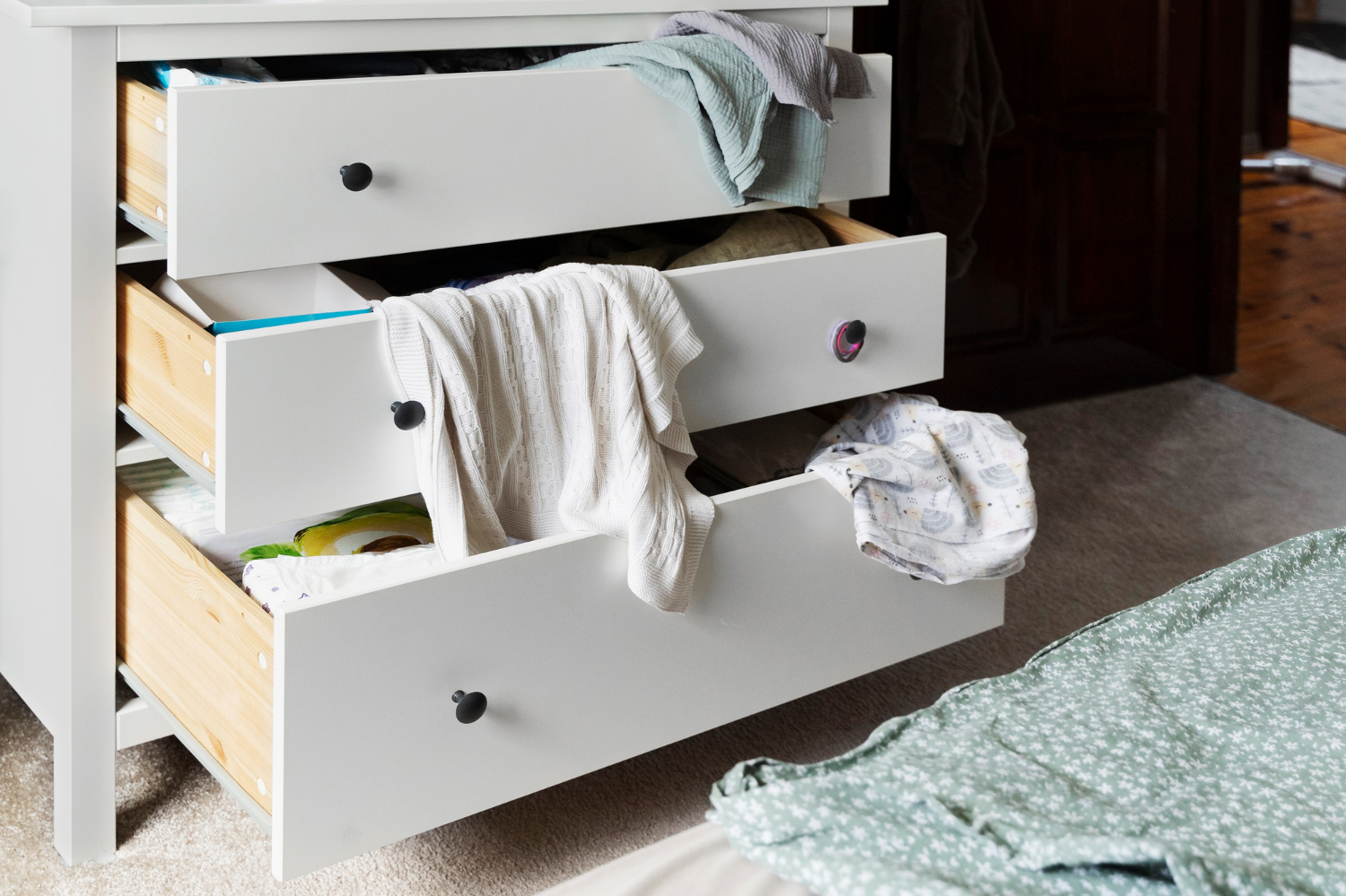
A dresser doesn’t usually fail all at once. It starts with a drawer that sticks a little. Then one that tilts when you open it. Eventually, something gives—usually right when it’s full.
Most of the time, the issue isn’t the exterior. It’s the drawer construction. That’s where durability lives or dies, and it’s also the part most people never check.
If you want a dresser that holds up, you need to understand what’s happening behind the drawer front.
Why Drawers Fail So Often
Drawers deal with constant stress: pulling, pushing, uneven weight, overloading. Cheap construction can handle that—for a while. Then things start to loosen, sag, or split.
The most common failure points:
- Weak joints at the corners
- Thin drawer bottoms that bow under weight
- Low-quality slides that wear out or misalign
- Poor materials that don’t hold screws well
Once one part fails, the rest usually follows.
The Gold Standard: Dovetail Joints
If you’re looking for a quick indicator of quality, this is it.
Dovetail joints interlock at the corners of a drawer, creating a strong mechanical bond that doesn’t rely entirely on glue or screws. You’ll recognize them by their wedge-shaped “teeth” along the edges.
Why they matter:
- Extremely resistant to pulling forces
- Hold up well under heavy loads
- Last for years without loosening
They’re common in higher-quality furniture—and rare in cheaper pieces for a reason: they take more time and precision to make.
Alternatives: Not All Joints Are Equal
Not every good drawer uses dovetails, but some alternatives are definitely better than others.
Good options:
- Dowels + glue
- Mortise-and-tenon construction
Less reliable:
- Staples
- Basic butt joints (just glued or nailed together)
If you see metal staples holding the corners together, that’s usually a sign the drawer wasn’t built for long-term use.
Drawer Bottoms: The Hidden Weak Spot
The bottom panel does more work than you think—it supports everything you put inside.
What to look for:
- Thicker panels (¼ inch or more is a good sign)
- Panels set into grooves (not just nailed underneath)
The worst-case scenario is a thin board stapled to the bottom. That’s the type that bows, pops out, or collapses under weight.
A properly slotted bottom distributes weight evenly and holds up much longer.
Drawer Slides: Where Function Meets Frustration
Even a well-built drawer can feel cheap if the slides are bad.
Side-Mount Metal Slides
- Common and affordable
- Usually reliable if well-installed
- Visible when the drawer is open
Undermount Slides
- Hidden beneath the drawer
- Smoother, quieter operation
- Often found in higher-end furniture
Wooden Glides
- Traditional and simple
- Can last a long time if well-made
- Not as smooth as metal options
What to avoid: flimsy slides that feel loose, grind, or don’t extend fully. These wear out fast and make everyday use annoying.
Materials Matter (A Lot)
The best drawer construction in the world won’t help if the materials are weak.
- Solid wood: strong, durable, holds joints well
- Plywood: a great middle ground—stable and resistant to warping
- Particleboard: prone to sagging, stripping, and breaking over time
If the drawer sides feel thin or lightweight, that’s usually a bad sign.
Weight Capacity: The Reality Check
Dressers aren’t just for clothes anymore—people load them with everything from denim stacks to random storage.
A well-built drawer should:
- Open smoothly even when full
- Stay level (no tilting or sagging)
- Close without force
If it struggles in a showroom or right after assembly, it won’t improve with time.
Assembly Still Matters
Flat-pack furniture isn’t automatically bad—but it does put more responsibility on assembly.
Loose screws, misaligned slides, or uneven panels can ruin even decent construction. Taking the time to assemble everything tightly and correctly can make a noticeable difference in how drawers perform.
A Quick Test You Can Actually Use
When checking a dresser (in-store or after delivery), try this:
- Pull the drawer out fully
- Gently lift at the front
A sturdy drawer will stay aligned and feel supported.
A weak one will tilt or shift immediately.
It’s a simple test—but very revealing.
A dresser that “doesn’t break” isn’t about brand names or price tags—it’s about how the drawers are built.
- Strong joints keep everything together
- Thick, supported bottoms prevent sagging
- Quality slides make daily use smooth
- Solid materials hold up over time
Ignore those details, and even a good-looking dresser won’t last. Pay attention to them, and you’ll end up with something that works just as well years from now as it did on day one.
Because with dressers, it’s not the outside that matters—it’s what’s holding everything inside.