
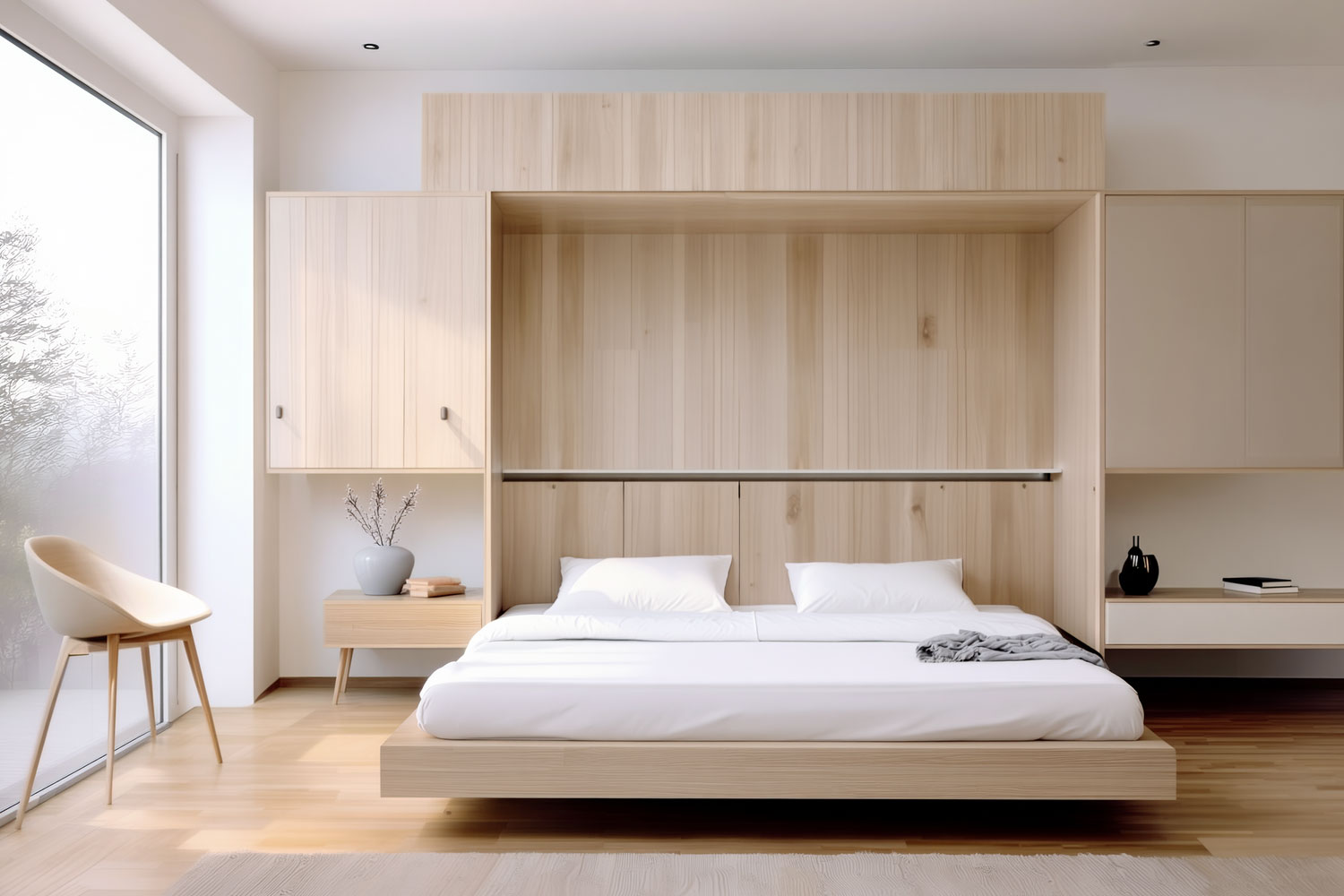
Murphy beds always sound like the perfect small-space solution. A bed that disappears into the wall and gives you your room back during the day? Hard to argue with that. But once you start looking at prices and installation, reality shows up fast.
The good news: you still have options. You just don’t have to go all-in on a traditional Murphy bed to get the same space-saving benefits.
Here’s a grounded look at budget-friendly Murphy bed ideas—and the alternatives that often make more sense.
What a Murphy Bed Actually Solves
At its core, a Murphy bed is just a folding bed that stores vertically or inside a cabinet to free up floor space. It’s especially popular in studios, guest rooms, and multipurpose spaces because it lets one room do two jobs. ()
During the day, you’ve got open space. At night, you’ve got a full sleeping setup. That flexibility is the whole appeal.
But there’s a tradeoff: cost, installation, and commitment.
The Reality of Budget Murphy Beds
Fully built Murphy bed systems aren’t cheap, especially once you factor in cabinets, hardware, and a compatible mattress. Even “entry-level” setups often end up costing more than expected once everything is included.
You also need:
- Wall anchoring (not optional for safety)
- Proper ceiling and floor clearance
- A mattress that fits thickness limits
And assembly can be a project. Some setups take hours—or even a full weekend—to install properly.
That’s why a lot of people start looking for alternatives once they see the full picture.
Budget-Friendly Murphy Bed Approaches
If you still like the idea of a Murphy bed but don’t want to overspend, there are a few practical routes:
1. DIY Murphy Bed Frames
Instead of buying a full cabinet system, some people build their own wall-mounted frames. It takes more effort upfront, but it can cut costs significantly if you’re comfortable with tools.
2. Murphy Bed Cabinets (Freestanding Units)
These don’t always require wall mounting, which makes them more renter-friendly. They’re simpler but usually smaller and better suited for occasional guests.
3. Mattress-first setups
Some ultra-budget builds focus on using a foldable mattress with a basic lifting frame or platform, rather than a full enclosure. Less polished, but much cheaper.
Smart Alternatives That Do the Same Job
Here’s the part people often overlook: Murphy beds are just one way to reclaim floor space. There are other options that can be more flexible—and easier on your wallet.
Sofa Beds (Sleeper Sofas)
Probably the most common alternative. A couch that turns into a bed means you’re not dedicating a whole wall system to sleeping. Newer designs are also more comfortable than older pull-outs, and some even include storage or USB ports for added utility.
Loft Beds
Instead of hiding the bed, you lift it. That opens up usable space underneath for a desk, seating area, or storage. It’s especially useful in small rooms where vertical space is underused.
Trundle Beds
A second bed slides out only when needed. This works well for guest situations without permanently taking up floor space.
Foldable Mattress Systems
High-density foam tri-fold mattresses can be stored in a closet or under furniture. Not glamorous, but extremely practical for tight budgets and occasional use.
The Hidden Tradeoff Nobody Mentions
Murphy beds save space—but they also add a daily step to your routine. You’re committing to folding and unfolding your bed every day.
Some people get used to it quickly. Others stop using the mechanism and just leave it down, which defeats the point.
Alternatives like sofa beds or loft setups remove that friction entirely.
What Actually Works Best in Tiny Spaces
It comes down to how you live:
- If your room must switch roles daily → Murphy bed or sofa bed
- If you need permanent workspace + sleep → loft bed
- If you just need occasional guests → trundle or foldable mattress
There’s no “best” option universally—just the one that fits how often you want to rearrange your space.
Murphy beds are clever, but they’re not the only smart solution.
Sometimes the most practical choice isn’t the one that hides the bed—it’s the one that makes your space easier to live in every day.
If your goal is a clutter-free, flexible room, focus less on the mechanism and more on how often you actually want to use it. That’s what makes the difference long-term.